
TURP vs HoLEP Surgery for Enlarged Prostate: A Comparison
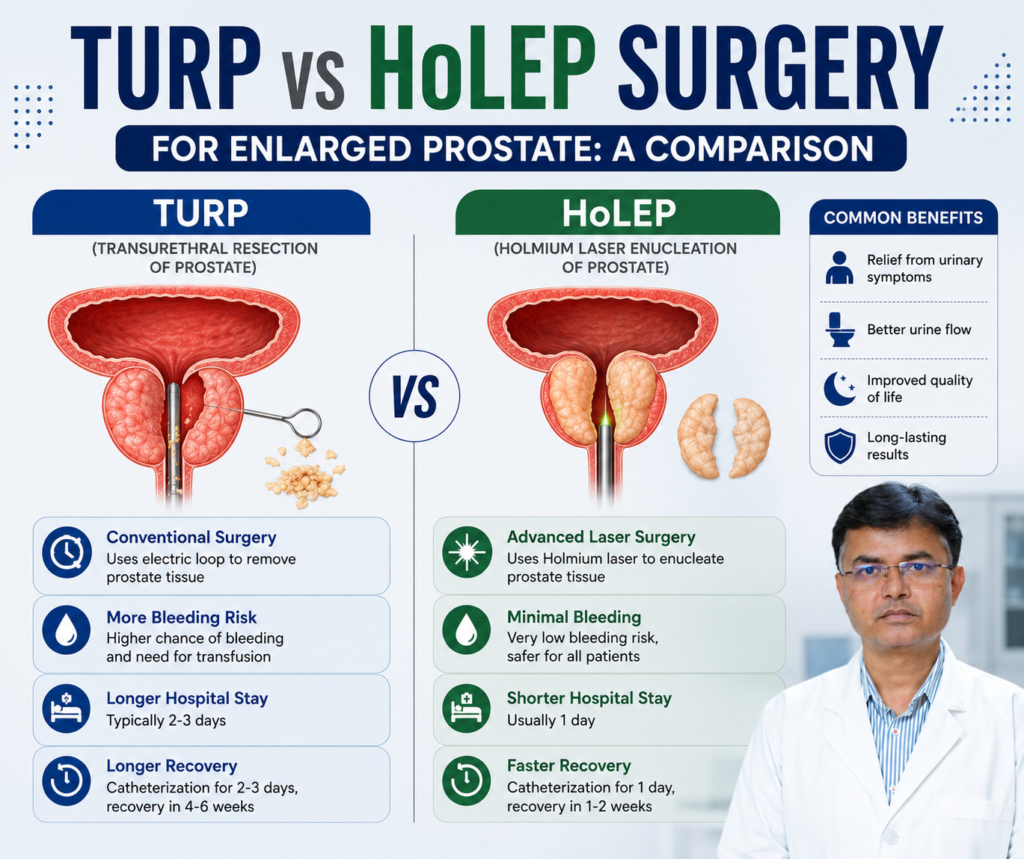
Benign Prostatic Hyperplasia (BPH), also described as an enlarged prostate, is a common condition among aging men. In this case, an enlarged prostate can block the urethra, and lead to several urinary issues such as urgency to urinate, a slow urine stream, a hard time starting to urinate, and a full bladder. If medication is not effective, surgery becomes the alternative option. Today, among the most effective surgeries are the HoLEP (Holmium Laser Enucleation of the Prostate) and the TURP (Transurethral Resection of the Prostate).
What are the differences between the two, and which is more effective? The following will outline both, in comparison, for a more informed choice.
What is TURP?
Referred to as the classic approach, TURP is known to be the treatment for moderate and severe cases of BPH. During TURP, a resectoscope is inserted in the urethra through which excess enlarged prostate is removed. This results in improved urine flow and reduction of urinary symptoms.
Benefits of TURP:
- History and experience of positive outcomes
- Improved symptoms of urinary flow
- Available in the majority of hospitals
- Used for medium sized prostates
TURP Prostate Surgery is a common procedure chosen by many in Noida for the reasons stated above.
What is HoLEP Surgery?
HoLEP is a laser prostate surgery that uses a holmium laser to excise enlarged prostate tissue. Tissue is detached from the prostate capsule, and subsequently, removed from the bladder. With its rapid recovery time and precision, HoLEP is one of the most popular prostate cancer surgeries.
Benefits of HoLEP:
- Minimal surgical bleeding.
- Applicable to enlarged prostates of all sizes.
- Shorter and easier recovery.
- Lower chance of repeat surgery.
- Quicker catheter removal.
HoLEP Laser Prostate Surgery in Noida is one of the most advanced laser surgeries and is one of the most preferred cancer surgeries.
TURP vs HoLEP: Key Differences
1. Effectiveness
Both procedures are effective in alleviating urinary symptoms. TURP has a higher chance of recurrence compared to HoLEP, which is more effective for bigger prostates and offers greater durability of results.
2. Bleeding Risk
As TURP involves cutting tissue through the use of electrical energy, there is moderate bleeding. Conversely, because HoLEP uses laser technology, blood loss is negligible.
3. Hospital Stay
TURP patients may require a longer hospital stay, and catheterization also lasts longer for TURP compared to HoLEP. Patients of the latter can be discharged sooner and can expect quicker recovery.
4. Large Prostates
TURP is also considered for prostates of a small to medium size, while HoLEP can treat very large prostates that do not require open surgery.
5. Long-Term Outcomes
Compared to TURP, studies indicate that HoLEP has a lower chance of needing additional treatments in the future, making HoLEP a superior choice for long-term treatment.
Which Procedure is Right for You?
Choosing TURP or HoLEP is dependent on a combination of:
- Prostate size
- Symptom severity
- General health
- Bleeding disorders
- Recommendation and experience of the surgeon
HoLEP can potentially be a great alternative for patients with bigger prostates who want a less invasive option with a quicker recovery. That being said, TURP is a safe, effective option for men with BPH.
Conclusion
Both procedures are very effective for surgery of an enlarged prostate. While TURP has been in practice for a while, HoLEP is newer, laser-based surgery that has less bleeding and faster recovery with great long-term results. The best way to determine which of these options are most effective for your case is to speak with a qualified urologist.
Dr. Lok Prakash Choudhary is a qualified urologist in Noida who performs both TURP and HoLEP surgery to men with advanced BPH and helps them manage their symptoms and regain their urinary health.