What Is ESWL and Who Can Benefit From Shock Wave Stone Treatment?
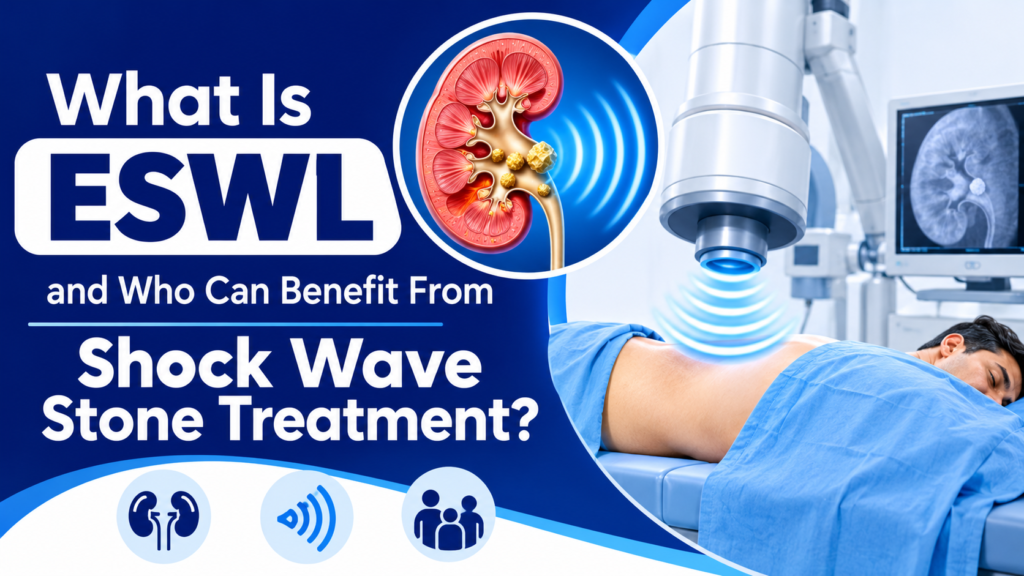
Imagine breaking a kidney stone without a single cut or scope entering the body. That is the idea behind shock wave treatment, a method that has helped countless people since the 1980s. It does not suit every stone, but for the right one it is wonderfully simple, and many patients are surprised at how little disruption it causes.
What ESWL Means
ESWL stands for extracorporeal shock wave lithotripsy. Extracorporeal simply means outside the body, and lithotripsy means crushing stones. Sound energy is generated by a machine and aimed through the skin at the stone, so nothing needs to be inserted.
How the Treatment Works
Using X-ray or ultrasound, the team locates the stone and focuses the waves precisely on it. Repeated pulses stress the stone until it cracks and crumbles into sand-like pieces. These tiny grains then travel down and leave the body with urine.
What a Session Feels Like
You lie on a table with a cushion or water-filled pad against your side. Most people feel a tapping sensation, and pain relief or light sedation keeps things comfortable. A session lasts roughly an hour, and you usually go home the same day, though someone should accompany you if sedation was used.
Who Can Benefit
People with stones of moderate size, generally under about two centimetres, in the kidney or upper ureter respond best. Those who want to avoid anaesthesia and incisions, and whose stone sits in an easily targeted spot, are often ideal candidates.
Who May Not Be Suitable
Pregnancy rules it out, as do untreated infections, bleeding disorders, and blood-thinning medicines that cannot be paused. A blockage below the stone, or a stone lying very deep behind bone or excess body tissue, can also make this method unsuitable.
Why Some Stones Resist
Not every stone breaks equally. Very hard stones, such as certain calcium and cystine types, may need several sessions or a different technique altogether. Size matters too, since larger stones produce more fragments that must all pass.
What Happens Afterwards
Drinking plenty of water helps flush the fragments. Mild aching, blood in the urine, and bruising on the treated side are common for a few days, but fever or severe pain should be reported straight away. Most people return to normal routines within a day or two and have a scan later to confirm clearance. Straining the urine to catch fragments can help identify the stone type.
When a Stent Is Involved
For larger stones, a thin drainage tube is sometimes placed beforehand to keep urine flowing. Arranging Kidney Stone Stent Removal in Noida once the fragments have passed completes the treatment and prevents the tube from staying longer than it should.
Getting Properly Assessed First
Whether this treatment is right depends on stone size, position, and hardness, all of which need imaging. Consulting a Kidney Specialist in Greater Noida before deciding helps you avoid a procedure that is unlikely to work for your particular stone.
Conclusion
Shock wave treatment remains a gentle and effective option for suitable stones, offering relief without incisions and with minimal downtime. The secret lies in choosing the right patient and the right stone. Dr. Lok Prakash Choudhary encourages anyone with a kidney stone to have it properly assessed, so the method chosen is the one most likely to succeed.